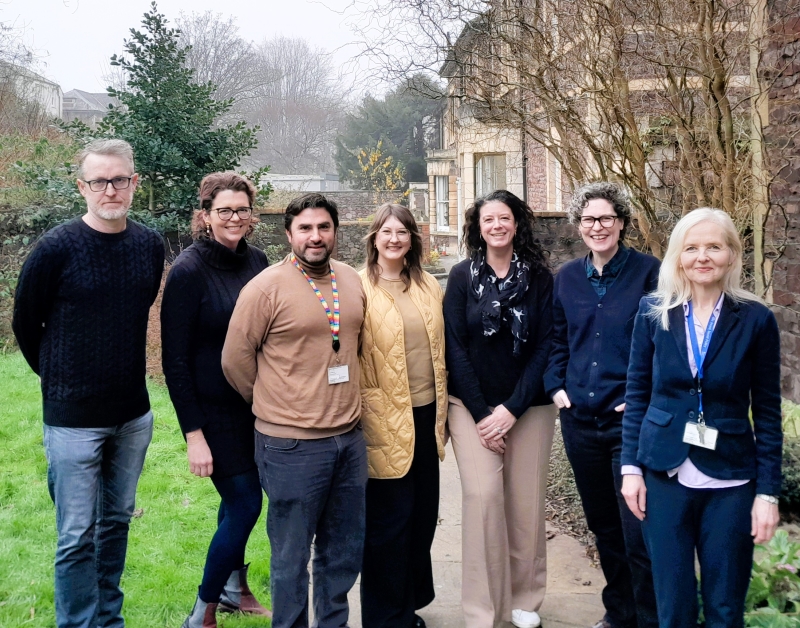
by the P&P editorial team: Chris Weible, Allegra Fullerton, Oscar Berglund, Elizabeth Koebele, Kristin Taylor, Claire Dunlop & Sarah Brown
Dear authors, reviewers, Editorial Board members, Early Career Editorial Board members, readers, and friends of Policy & Politics,
As 2025 draws to a close, we want to extend our sincere thanks to all of you. Your scholarship, rigour and sustained engagement have played a central role in making this another strong year for the journal and the blog. In this final blog of 2025, we reflect on P&P’s achievements this year, feature our most popular blog in 2025, showcase the highest number of open access articles we’ve published this year, and consider the year to come with gratitude for our community and hope for the future of the journal and its contribution to policy scholarship.
Reflections on 2025
This year, thanks to the ongoing support of our community:
- Our readership has quintupled over the last 5 years, representing the highest increase since the journal started publishing in 1972. This is one of the strongest motivators for us on the journal team, and we are so grateful to have such an engaged and loyal following, thank you!
- Submissions reached their highest level in more than a decade, reflecting both the vitality of public policy scholarship and the professional respect many of you tell us you have for Policy & Politics as an outlet for your best work.
- We published a broader range of international scholarship than ever before, with contributions from an increasingly diverse set of countries and research contexts.
- We maintained our position in the top quartile of journals in both Public Administration and Political Science, made possible through the collective effort of authors, reviewers and Board members.
We remain grateful to all of you for sustaining the journal’s quality and intellectual ambition.
Our most popular blog of 2025
We are delighted to share that our most widely read blog post of 2025 was “Metagoverning collaborative networks: a cumulative power perspective” by Alexander L. Q. Chen & Oda Hustad. Here, the authors examine how collaborative governance networks are subtly steered through metagovernance, introducing a new framework that distinguishes between output-, input-, and process-based forms of indirect control. Using an illustrative Danish case, the authors show how these mechanisms accumulate to shape participation, decision-making, and outcomes—shedding light on power dynamics that often remain hidden in accounts of collaboration. Their contribution lies in demonstrating that even “horizontal” networks involve significant, cumulative power, and in offering scholars a clearer way to analyse when such power empowers participants and when it marginalises them.
Open access highlights: Making more open research accessible than ever
We are particularly proud to have published a record number of open access articles in 2025, helping to broaden the reach and impact of the research we publish. These included:
- Experts in governance: a comparative analysis of the Nordic countries
Johan Christensen, Stine Hesstvedt, Kira Pronin, Cathrine Holst, Peter Munk Christiansen, and Anne Maria Holli
- Lived experience as evidence in anti-poverty policy making: a governance-driven perspective
Clementine Hill O’Connor and Hayley Bennett
- How do policy and design intersect? Three relationships
Liz Richardson, Catherine Durose, Lucy Kimbell, and Ramia Mazé
- The performance of accountability and the treatment of experts by politicians: UK parliamentary select committees during the COVID-19 pandemic
Felicity Matthews and Matthew Wood
- Towards a new policy analytical methodology in the study of vaccination governance: from values to valuations
Katharina T. Paul
- The democratising capacity of new municipalism: beyond direct democracy in public–common partnerships
Iolanda Bianchi
- How middle managers perceive and articulate the discrepancy between socio-health service delivery goals and practice
Janna Goijaerts, Natascha van der Zwan, and Jet Bussemaker
- A new measurement model and database of the democratic qualities of regulatory bodies
Libby Maman, Jacint Jordana, David Levi-Faur, Edoardo Guaschino, Rahel Schomaker, and Esther Van-Zimmeren
- The role of engineering advice in policy making: the case of energy policy in the UK
Laurent Lioté, Adam Cooper, and Neil Strachan
- The inefficiency of centralised control and political short-termism: the case of the Prison Service in England and Wales
Sam Warner, David Richards, Diane Coyle, and Martin J. Smith
Looking ahead to 2026
As we look towards 2026, we remain encouraged by the journal’s continued growth: rising submissions, expanding global participation, sustained interest in open access and strong engagement with our blog. We hope you will continue to contribute—through submitting, reviewing, reading and sharing research.
Thank you once again for your support throughout 2025. We wish you a restful break and all the best for the year ahead.
 Policy & Politics Journal Blog