by the P&P editorial team: Chris Weible, Allegra Fullerton, Oscar Berglund, Elizabeth Koebele, Kristin Taylor, Claire Dunlop & Sarah Brown
Dear authors, reviewers, Editorial Board members, Early Career Editorial Board members, readers, and friends of Policy & Politics,
As 2025 draws to a close, we want to extend our sincere thanks to all of you. Your scholarship, rigour and sustained engagement have played a central role in making this another strong year for the journal and the blog. In this final blog of 2025, we reflect on P&P’s achievements this year, feature our most popular blog in 2025, showcase the highest number of open access articles we’ve published this year, and consider the year to come with gratitude for our community and hope for the future of the journal and its contribution to policy scholarship.
This quarter’s Policy & Politics highlights collection brings together three of our most popular articles recently published, that extend and deepen our theoretical and empirical understanding of collaborative governance. Each article advances our knowledge by engaging critically with key debates in the field, whether through conceptual synthesis, empirical exploration, or theoretical refinement. Together, they contribute to our understanding of the complexities and contingencies of collaboration in contemporary governance settings.
Collaboration in cross-sectoral networks is proliferating in response to different public policy issues such as climate change, public health crises, economic inequality and urban renewal. These collaborative networks are typically characterised as horizontal partnerships, where public, private, and civil society actors have equal power, and work together to achieve shared goals. Yet, some form of governance is necessary for collaborative networks to succeed as they otherwise risk becoming inefficient. But how can power be exercised in the governance of collaborative networks without undermining the capacity of these networks to solve collective problems? This is the question we asked in our article recently published in Policy & Politics, entitled “Metagoverning collaborative networks: A cumulative power perspective”.
Metagovernance is a suitable way of governing collaborative networks, as it relies on a complementary mix of subtle governance mechanisms to indirectly steer collaborative networks towards achieving their goals. In our article, we developed a new framework to understand how power is exercised in collaborative networks through metagovernance. Our framework outlines three types of metagovernance (outputs, inputs, and process) that can be used at different stages of the collaborative process:
Metagoverning outputs: issuing formal project output requirements (legal, financial, administrative) or expressing informal expectations about the project outputs
Metagoverning inputs: selectively enlisting and excluding actors as participants or normatively framing the values, interests, and identities of project participants
Metagoverning processes: steering the conceptual content of the collaborative process toward predefined output goals, for instance by controlling access to resources such as time and knowledge.
Metagovernors can gradually steer collaborative networks towards specific goals based on these three collaborative stages, where power can be exercised repressively or constructively. To show how these insights unfold in practice, we encourage you to read our full article where we present an illustrative case study of the development of a sustainable and socially inclusive craftsmanship dormitory in Denmark. This project was developed in a collaborative network involving teams of architects, artists, students, and consultants (metagovernors), showcasing both the constructive and repressive aspects of power exercised through metagovernance.
Special issue blog series on Policy Expertise in Times of Crisis
Peter Aagaard, Sevasti Chatzopoulou, and Birgitte Poulsen
Crisis seems to be everywhere these days. Where there is crisis, there is crisis management. And where there is crisis management, there are experts that advise politicians in decision-making. However, how does this sustained pressure from crises affect relationships between experts and politicians? Has expertise increasingly become politicised? Or do we see more scientisation of politics? And do relationships between experts and politicians vary across different political systems? These are all central questions addressed in our recently published article on Analysing expert advice on political decisions in times of crisis. They are important questions, because they deal with the legitimacy of decision-making and public sense-making in the era of recurring crises.
In our article, we study how a crisis, like COVID-19, affected expert–politician relationships in Denmark, Greece, and the United States. Despite their differences, there were traces of the politicisation of expertise in all three cases. However, experts did not hold sway over elected politicians in any of the countries. In all three countries politicians relied on science selectively (also as partisan expertise) to publicly legitimise their strategies and decisions. The frontstage influence of experts played a minor but significant part across all three cases. Experts were aware of their role in the media during the crisis, often feeling a need to defend their science, perhaps even in opposition to their own government. (Perhaps you remember Fauci?)
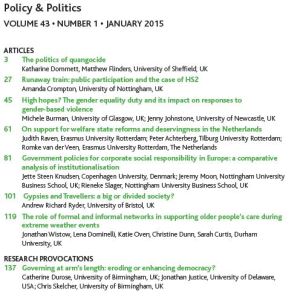
Policy & Politics, Volume 43, issue 1, is now available in print and online. David Sweeting introduces the issue.
The latest issue of Policy & Politics showcases some of the most creative and innovative work that is going on in the field, covering a variety of topics. As ever, the contributions combine theoretical insight with empirical analysis, and offer a wide geographical spread. The issue also contains our first ‘research provocation’ piece.
What do social democratic parties do after they regain power after the Third Way? This was the guiding question for our study of the public policies of the current Danish social democratic government (2011-2015). The Third Way (TW), with Britain’s New Labour as its forerunner, was at first a successful strategy for many European social democratic parties to regain power after long bourgeois incumbencies in the 1980s and 1990s. However, it usually ended in electoral disaster since TW policies did not square with the preferences and values of many social democratic core voters who then abstained or shifted to Continue reading →





 Policy & Politics Journal Blog