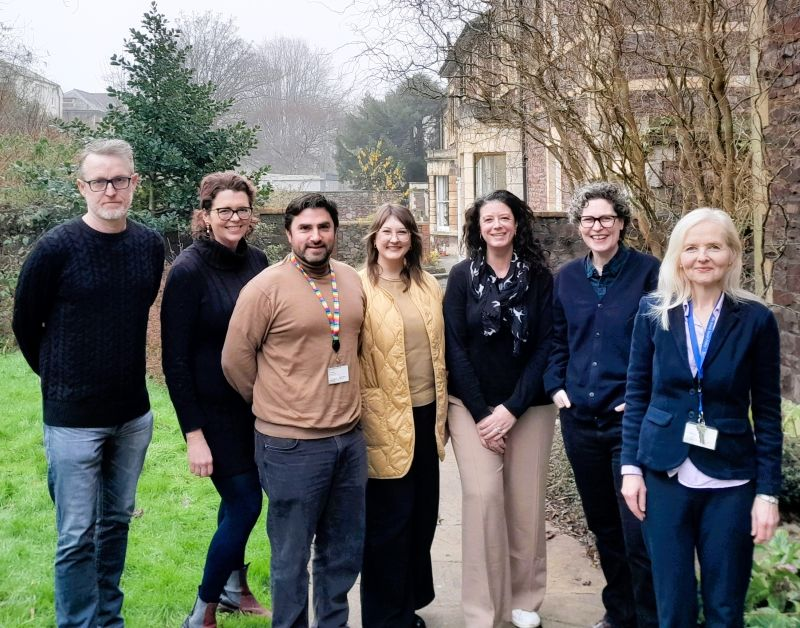
Introducing new P&P co-editor Kristin Taylor!


We’re excited to welcome Kristin Taylor as a new co-editor of P&P in January! In anticipation, we caught up with her to find out a bit about her motivation for joining our team… 

SB: Hey Kristin, we’re thrilled to have you joining our illustrious team in 2025 and wanted to hear what made you want to take on a co-editor role for P&P, and what you hope to get out of it? 

KT: I’m glad the feeling is mutual! I was quite humbled when the editorial team approached me about the role. I have always held P&P in high regard because of the incredibly collegial and constructive review process. Given all the thoughtful effort the co-editors have devoted to the quality of P&P, I am honored to join the team. With that being said, I haven’t thought so much about what I hope to get out of being a co-editor of P&P, but I have thought quite a bit about what I can contribute to the journal and the editorial team. One of the aspects of my career that I have relished as I’ve become more established is the opportunity to mentor the work of new, up and coming scholars of public policy. I’m excited about the chance to contribute to the journal by fostering the work of new voices in the literature.  

SB: We know that balancing priorities such as research, teaching and administration is more pressurised for prolific researchers like you, so what do you anticipate the benefits of the role will be for you? 

Continue reading

Thank you to all our authors, reviewers, board members, readers and friends of Policy & Politics for another successful year in 2022

Oscar Berglund, Claire Dunlop, Elizabeth Koebele, Chris Weible and Sarah Brown

Screenshot 2022-12-12 171359

Thank you to all our authors, reviewers, board members, readers and friends of Policy & Politics for another successful year in 2022.

We are delighted to be ending the year on the high note of maintaining our top quartile ranking in Political Science with an impact factor of 3.297, thanks to the huge support of our loyal community. Congratulations to you all!  

We are looking forward to seeing many of you face to face in 2023, particularly at the Conference on Policy Process Research in Denver in January, and at the International Conference on Public Policy in Toronto in June.

In the meantime, to celebrate all we have achieved together this year, we have made our top 10 most highly cited articles published in 2022 free to access until 31 January 2023, please see below for the full collection.

Continue reading

2022 Policy & Politics Annual Lecture with Jess Phillips MP on “Everything You Really Need to Know About Politics”

Oscar Berglund, co-editor Policy & PoliticsSPS Staff Portraits, University of Bristol

Last night, Policy & Politics was delighted to host Jess Phillips MP to speak to a large audience in Bristol about ‘Everything You Really Need to Know About Politics’.

Jess has been MP for Birmingham Yeardley since 2015 and is arguably one of Britain’s most prominent feminist politicians.

The aim of Phillips’ talk, based on her recent book of the same title, was to demystify British politics in an effort to strengthen the relationship between citizens and their elected representatives. The general scorn for politicians that is so common across the UK serves the Conservatives, she says. When people say ‘What’s the point in voting? You’re all the same’, people think that they are soldiers, that they are taking a stance. But on the contrary, to Phillips, it sounds like surrender.

Continue reading

New Frontiers & Cardinal Challenges for Scholars of Policy & Politics

P&P 2021 EditorsOscar Berglund, Claire A. Dunlop, and Christopher M. Weible

Policy & Politics serves as the ecumenical journal for the sects and strands found in the studies of social policy, public policy, policy processes and politics. It offers a home for scholars espousing a plurality of ontological, epistemological, and methodological orientations to share their science, learn and challenge each other, and enhance their knowledge. Continue reading

Policy & Politics: Serving and Enhancing our Metacommunities

Oscar Berglund, Claire Dunlop and Christopher M. Weible

In the study of ecological systems, there is a concept called metacommunities. The idea is that a species might be dispersed in different yet interconnected communities.  These metacommunities might emerge and grow for reasons of fit, space, survival, or chance.  These metacommunities interconnect through some species traversing between them either rarely or habitually. Over time metacommunities might also evolve and adapt to their particular niches. For those who care about supporting ecological systems that might be dispersed in interconnected niches, metacommunities provide a broad language and perspective to help visualize, understand, and govern.

As editors for Policy & Politics, we view this metaphor of metacommunities apt for describing the broadly defined field of public policy, which is dispersed in many communities, each with their own research approaches, lexicons, and traditions.  We also see that some scholars navigate between communities more than others.   In describing academia, we often refer to these metacommunities as silos where some silos are more isolated or connected than others as well as some silos existing within other silos.  Similar to metacommunities, silos might emerge and grow as scholars search for space to develop their ideas, self-sort with others of similar orientations, and more. Continue reading

Thank you to all Policy & Politics reviewers in 2019!

Thank you to all our reviewers in 2019 

On behalf of the authors and readers of Policy & Politics, the Co-Editors wish to wholeheartedly thank those who reviewed manuscripts for us in 2019.

With a high 2 year impact factor of 2.028, and a 50 year tradition of publishing high quality research that connects macro level politics with micro level policy issues, the journal could not exist without your investment of time and effort, lending your expertise to ensure that the papers published in this journal meet the standards that the research community expects for it. We sincerely appreciate the time spent reading and commenting on manuscripts, and we are very grateful for your willingness and readiness to serve in this role.

We look forward to a 2020 of exciting advances in the field and to our part in communicating those advances to our community and to the broader public.

Policy & Politics Co-Editors: Sarah Ayres, Steve Martin & Felicity Matthews

p&p editors

If you enjoyed this blog post, you may also be interested to read:

Narratives as tools for influencing policy change [Open Access]

Three habits of successful policy entrepreneurs  [Open Access]

Can experience be evidence? Craft knowledge and evidence-based policing [Free]

2018 Impact Factor announcement: Read our most highly cited articles

P&P editors

Sarah Ayres, Steve Martin, Felicity Matthews – Policy & Politics Editors

We are delighted to announce that Policy & Politics has achieved a fantastic result in this year’s Journal Citation Reports with its highest ever Impact Factor of 2.028. The journal is now in the top 20 of the Public Administration category and the top 50 for Political Science.

This impressive outcome is testimony to the outstanding quality of research produced by our authors, the meticulous scrutiny of our peer reviewers, and the hard work of the Policy & Politics and Policy Press team. We would like to offer our thanks and congratulations to all.

To celebrate this increase, we have made the most highly cited articles which contributed to the 2018 Impact Factor free to read until 31 July 2019: Continue reading

2019 P&P Annual Lecture with Baroness Sayeeda Warsi on Muslim Britain

OscarOscar Berglund
Digital Associate Editor for Policy & Politics

Policy & Politics was delighted to welcome the Rt Honourable Baroness Sayeeda Warsi to speak to audiences in Bristol last night on her topic of being Muslim in Britain.

Baroness Warsi was the UK’s first Muslim Cabinet minister and has become a leading voice in the British debate on Islamophobia, not least within the Conservative Party.

Baroness Warsi began her lecture by saying that the recent shocking Islamophobic terror attack in New Zealand highlighted the importance of ‘having an open conversation’ to dispel the myths about what it means to be Muslim. In the current environment, where Islamophobia has become acceptable in so many areas of society, the Christchurch terrorist attack, she says, neither shocked nor surprised her. This conversation about the relationship between Islam and Britain is what Sayeeda Warsi seeks to promote in her book The Enemy Within: A Tale of Muslim Britain. This is a relationship stretching back to the 7th century that has suffered over the last couple of decades. She asks, ‘How do we reset this relationship?’ Continue reading

Understanding academic impact: fear and failure, stealth and seeds

Matt FlindersMatthew Flinders

This blog post was originally published on the Oxford University Press Blog on 8 August 2018.

Failure is an unavoidable element of any academic career. For all but a small number of ‘superstar über-scholars’ most of the research papers we submit will be rejected, our most innovative book proposals will be politely rebuffed, and our applications for grants, prizes and fellowships will fall foul of good fortune. There is, of course, a strong correlation between ambition and failure in the sense that the more innovative and risky you try to be, the bolder the claims you try to substantiate, and the ‘bigger’ the journal you try to publish in the higher your chances of rejection.

Continue reading

Updating your course reading lists? Check out our essential reading recommendations from Oscar Berglund, Digital Associate Editor for Policy & Politics

OscarOscar Berglund,
Digital Associate Editor for Policy & Politics

All articles mentioned in this blog post are free to access until 20th September. 

This time of year, many of us involved in teaching are looking at how to refresh our reading lists for the upcoming academic year. Here at Policy & Politics, we thought that we would give a little helping hand with that by going through some of our latest content that we think will help students understand the things we try to teach.

For those of us teaching concepts, models and theories of the policy process, the recent Weible and Cairney special issue on ‘Practical lessons from policy theories’ is a gold mine where many of the papers give a good account of their respective field, whilst seeking to take the concepts forward and increase their policy relevance. This includes articles on the Multiple Streams Approach, Institutional Analysis and Development, Punctuated Equilibrium Theory and the Advocacy Coalition Framework that will all help students make sense of these concepts.  Continue reading