Why social inequality persists

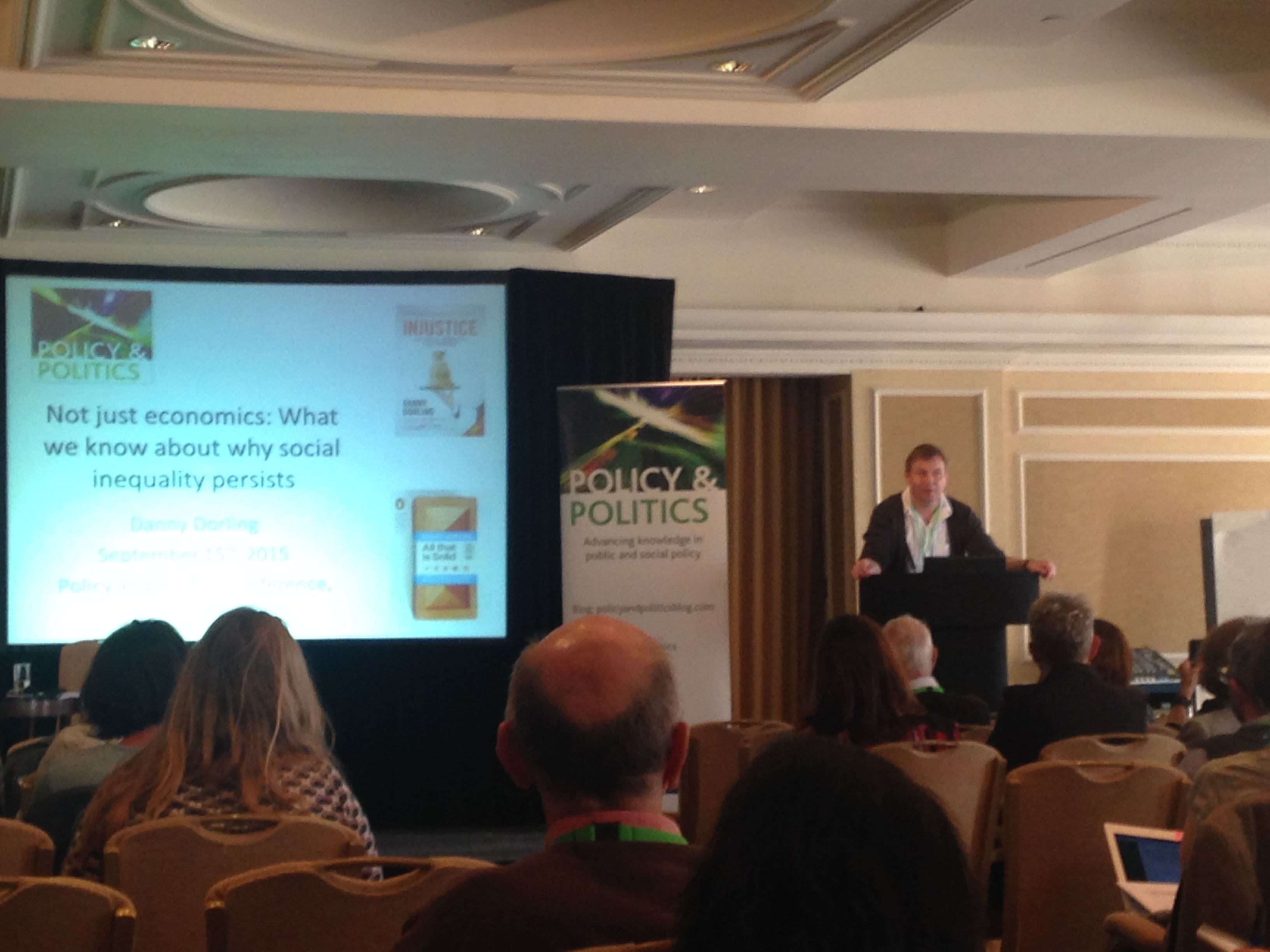
IMG_3926by Tessa Coombes, guest blogger for P&P Conference 2015.

The second plenary session of the Policy and Politics Annual Conference was delivered by Prof. Danny Dorling, who provided a shocking and somewhat scary analysis of the increasing levels of inequality in the UK. The big question for us all to consider is why there is no consistent challenge to this situation and why we appear to accept the disparities that exist. Why is it acceptable and why would anyone think inequalities are a good thing?

One answer to the question is that we don’t actually realise how unequal we are as a society. But a quick look through some of the statistics soon provides the evidence we need. Danny took us through graph after graph that more than adequately demonstrated just how big the problem is and that it is increasing. One example to illustrate the point, in 2010 the best off tenth of the population in the UK were nearly 14 times better off than the worst off tenth. By 2015 this had grown to more than 17 times better off, and if the trend continues on a similar course in less than 20 years the best off will have over 24 times as much disposable income as the worst off. The problem is that the change is gradual, we don’t notice it so much and we get Continue reading

Gender budgeting and public policy: the challenges to operationalising gender justice in India

Nakray
Keerty Nakray

Dr Keerty Nakray discusses her Policy & Politics article article Gender budgeting: does it really work?

This year marks the culmination of the Millennium Development Goals 2015 (MDGs) which provide the watershed for the global community to evaluate its development victories and failures. It is time to engage in collective reflections on lessons learnt and also to re-evaluate strategies in order to continue efforts to improve the quality of people’s lives. The MDGs reflected the consensus amongst world leaders to address eight goals: to eradicate extreme poverty and hunger; to achieve universal primary education; to promote gender equality and empower women; to reduce child mortality; to improve maternal health; to combat HIV/AIDS, malaria and other diseases; to ensure environmental sustainability and to develop a global partnership for development.

Gender equality was one of the ambitious goals of the MDGs with gender budgets receiving widespread endorsement as one of the most important strategies to achieve it. However, to the dismay of the feminist movement, gender Continue reading

Professor Big Brother and his radical students – who should we fear most?

by Akil N Awan, Lecturer in Political Violence & Terrorism at Royal Holloway

This post was originally published on The Conversation blog on 29th January 2015

The Counter-Terrorism and Security Bill 2014-15, having been rushed through the House of Commons with alarming speed and ease, has passed its second reading in the House of Lords. It is now in the final committee stages and on course to become law within a matter of weeks.

Although peers rejected a raft of amendments that would have effectively brought the “snooper’s charter” in through the backdoor, the addition of this major piece of terrorism legislation to our existing terror laws still has serious implications and should be of real concern to us all. Not least because it co-opts Continue reading

Where are the Women?

Karen Miller and Duncan McTavish

Karen Miller and Duncan McTavish from Glasgow Caledonian University discuss their latest article for Policy & Politics, ‘Representative Bureaucracy‘. 

As we approach the UK General Election in May 2015, and in 2018 the centennial anniversary of the suffragettes’ struggle, the absence of women in politics and public life is stark. Political and public institutions which formulate and implement equality policies often lack representation of minorities at the senior echelons of power. Our question of where are the women belies a more fundamental question of how can policies, which are formulated with objectives to achieve equality, be formulated by decision makers Continue reading

Does ‘Localism’ empower the already powerful? And what do we know about how this happens?

Annette Hastings
Annette Hastings

by Annette Hastings, University of Glasgow

“To each that hath shall be given, and he shall have abundance, but from him that hath not shall be taken away even that which he hath.  The Gospel according to Matthew, 13:12.

I don’t tend to quote the Bible (or indeed any religious text) very often. This Biblical reference does however draw attention to the fact that we have been concerned about the so-called ‘Matthew effect’– or the law of accumulated advantage – for some considerable time. The research (and indeed the policy community) have been rather reluctant to devote very much time and effort to understanding how and why those who are already in positions of advantage are better able to extend that advantage, in comparison to deprived social groups,  when it comes to interacting with the local state and in particular public services.

In our free- to- download paper (further evidence that the more you have the more you get!) Peter Matthews from Stirling University and I use an understanding of class interests derived from the work of Pierre Bourdieu to try to understand how it is that public policy processes can empower the already powerful. Continue reading

Why is Labour demonising the poor and widening social inequalities?

Embargoed until 21st August 2014

Peter Taylor-Gooby
Peter Taylor-Gooby

In a recent announcement about cutting youth unemployment benefits, Ed Miliband taps into prevailing public opinion by insisting that those on benefits must work to acquire skills in order to deserve them. The way he speaks of those who claim benefits is completely in tune with those who demonise the poor, with sound bites such as ‘Labour… will get young people to sign up for training, not sign on for benefits’.[i]

This prevailing belief is in stark contrast to two key trends over the last few decades, argues Peter Taylor-Gooby, Professor of Social Policy at the University of Kent in a paper to be published in Policy & Politics. He explains: “The first is that about three-fifths of people below the poverty line live in households where there is at least one full-time earner. Much working-age poverty is a problem of low wages, not of unemployment and ‘spongers’. Secondly, spending in other areas of the welfare state such as health care, pensions and education has grown very much faster than the benefits directed at the poor, unemployment benefit and social housing. Spending on the poor is unimportant as a cause of current public spending problems.” Continue reading

Poverty and social policy in Europe 2020

Paul Copeland and Mary Daly

Paul Copeland, Queen Mary University of London, and Mary Daly, University of Oxford offer a critical analysis of EU social policy in their article available in the latest issue of Policy & Politics.

Having written about EU social policy for over a decade, our view is that the EU currently is going nowhere in its social policies to combat poverty and social exclusion. Such policies are in themselves ambitious and also novel in an EU context – centring on the 2010 target within the EU’s Europe 2020 reform programme, the EU aims to reduce the numbers living in poverty and social exclusion by 20 million by 2020. While this broke new ground when it was agreed we remain skeptical in terms of the ability of the EU to make progress and achieve substantive positive outcomes on poverty. In our paper we construct a framework to analyse the significance of a policy area within a governance architecture, such as Europe 2020. Continue reading

Credit Union Modernisation and the Limits of Voluntarism

Stephen Sinclair
Stephen Sinclair

Stephen Sinclair ponders how far voluntarism can be pushed in his recent paper in Policy & Politics. In this blog he discusses what prompted him to the write the paper and gives an overview of the key themes.

Like many people, I have to attend a lot of meetings and not all of them are very interesting. So when what I expected to be a rather dry and technical event turned into a heated debate it is worth further reflection. There would seem no reason to expect a seminar outlining the UK government’s proposals to reform credit unions to be particularly contentious; however this paper discusses the raw nerve that this meeting exposed. The sensitive issue at stake was the basic questions of what and who credit unions are for. Continue reading

The Politics of Poverty in the European Union

Florence Larocque and Alain Noël

Florence Larocque and Alain Noël discuss their article on the politics of poverty in the European Union, published in the latest issue of Policy & Politics.

“Arguments about poverty,” note Paul Copeland and Mary Daly in a recent article, “go to the heart of political disagreement in Europe,” because they express profound differences about social policy and models of capitalism. The European commitment to fight poverty and social exclusion has thus moved over the years, from the ambitious decision to make social inclusion an explicit goal governed by the new Open Method of Coordination (OMC) with the Lisbon strategy in 2000, to a more circumscribed vision giving priority to economic growth and job creation after 2005, and to an ambiguous but nevertheless explicit quantitative target agreed upon in the summer of 2010, “to lift at least 20 million people out of the risk of poverty and social exclusion” by 2020. But changing orientations at the European level are not the only manifestation of political disagreement about poverty. Important differences are also expressed through the distinct ways member states have interpreted the common objectives. Continue reading

We need to talk about poverty

Seosamh Mac Cárthaigh

Seosamh Mac Cárthaigh discusses the background to his article on ‘Need and poverty’ which is about to be published in the next issue of Policy & Politics.

How much poverty is found in a society depends on how poverty is defined and measured. In an obvious sense, the definition of poverty must come first. If we do not have a clear understanding of what it means to say that people are poor, we are unlikely to be able to devise measures which yield meaningful estimates of the number of people who can be so described.

Unhappily, the meaning of poverty is often taken for granted in scholarly research on the topic. It is not uncommon for estimates of poverty to be presented without any supporting discussion of how those estimates are to be interpreted. Where issues of interpretation are addressed, the discussion is frequently limited to a few paragraphs or even sentences. While studies usually offer some description of the measures used, they generally have little to say about why those measures were chosen in the first place or about what they are intended to capture. Continue reading