What Ever Happened to Home Ownership and Asset-based Welfare?  

ronald_lennartz_kadi

Richard Ronald (University of Amsterdam), Christian Lennartz (University of Amsterdam, and Justin Kadi (Bauhaus-Universität Weimar)

An extended version of this post was originally published  on 3 January 2017 in the Policy Briefing section of Discover Society which is provided in collaboration with the journal Policy & Politics. The original post is available at  http://discoversociety.org/category/policy-briefing/.

Owning your own home has long been recognized as a form of asset-based welfare in policy terms. Historic growth in home ownership and house prices has advanced the assumption that housing equity fulfils a welfare function by acting as a store of wealth or even a reserve of cash. However, as Richard Ronald argues, a clear consequence of this policy has been to widen the gap between rich and poor families, as well as between young and old, with access to housing and housing wealth becoming a critical dimension of social inequality, especially since the last financial crisis.  Continue reading

Individualised disability funding in Australia and England – different design, same challenges

needham-and-dickinsonCatherine Needham, University of Birmingham and Helen Dickinson, University of Melbourne

In July 2016, the full national roll out began of Australia’s National Disability Insurance Scheme (NDIS).

This scheme, which has been piloted in several localities in the last three years, constitutes a major new investment in disability services in Australia. We have been undertaking research and writing on the implementation of NDIS and comparing it to our earlier research on personalisation and a critique of individual budgets and personalisation in English social care services. Continue reading

New domestic violence policy to hand back control to victims – but does it?

DugganDr Marian Duggan, Lecturer in Criminology, University of Kent

Domestic violence is never far from the news.

With an average of two women a week being killed by a current or former partner, and an increasing number of cases involving the murder of children too, initiatives to address this form of interpersonal victimisation have been increasingly prioritised by governments.

One such initiative in the UK is the Domestic Violence Disclosure Scheme (DVDS). Launched on International Women’s Day (8th March) 2014 by Home Secretary Theresa May MP, the DVDS offers members of the public the ‘right to ask’ the police for information about a partner’s past if they are concerned that there is a history of domestic violence or violence against women. The policy was heralded by the Home Secretary as part of a “raft of measures” designed to “hand control back to the victim by ensuring they can make informed decisions about their relationship and escape if necessary”.

Continue reading

Same Sex Marriage and the Church, by Rev. Richard Coles

Tessa Coombes
Tessa Coombes

by Tessa Coombes, University of Bristol

The Reverend Richard Coles of Radio 4 and ‘The Communards’ fame, presented this year’s Policy and Politics Annual Lecture, the 21st in the series. The theme of the lecture was same sex marriage and the church, delivered by the Reverend as a ‘ramble down memory lane’ and very much part of his own personal life story.

The lecture was, by turns, amusing, informative and challenging as well as saddening. It veered from funny anecdotes to tales of tragedy; from personal life events to big questions of principle. Overall it was a brilliant piece of oratory with just the right level of information and challenge, as well as being more than sufficiently thought provoking.

2016 Annual Lecture audience (smaller)
Richard addresses the crowd

Richard’s life story is well documented in his autobiography “Fathomless Riches: Or How I Went from Pop to Pulpit” published in 2014. It’s a colourful story of a young gay man from middle England making his way to London and becoming part of an ‘alternative gay culture’. In his presentation he described London in the 1980s as a polarized city: a place where Thatcher and Livingstone epitomized the ‘twin poles of values in the battlefield of London”. He saw it as a city where post-punk democratization was evident and an alternative gay culture was emerging, one with a ‘hard-left’ basis and a tribal culture, with a political common purpose. He told us about his involvement with the lesbian and gay support for the striking miners of South Wales, recently depicted in the film ‘Pride’. He describes the mid 1980s as a time of experimentation, creativity and excitement, when he found himself surrounded by a small group of people that came together to epitomize a significant cultural and political moment in gay history. Continue reading

Viewpoint from Danny Dorling on Inequality and the 1%

Danny Dorling
Danny Dorling

Over the festive period, spare a thought for the 1% lowest earners in the UK. Read on if you care…

The Conservatives won a narrow majority in May 2015. The result shocked a London based commentariat. This was hardly surprising as the Capital swung to Labour and London remains where life’s winners congregate, a place from where losers must be expelled. It was life’s losers who did not turn out to vote for the main alternative on offer, a watered-down version of Conservative austerity being sold to them by Ed Miliband. We were then told that the Labour Party did not appeal enough to those who were aspirational and wanted more, including people who wanted more largely irrespective of who had to have less. But perhaps fear and fantasy greatly appealed too, an eighth of the English electorate voted for the UK Independence party (UKIP).

In Scotland all but three of the constituencies fell to the Scottish National Party (SNP) which now represented as wide a cross-section of society as it is possible to imagine. The former Royal Bank of Scotland oil economist, Alex Salmond became Continue reading

Inspired by the issue: The challenges to operationalising gender justice in India

Geetanjali Gangoli
Geetanjali Gangoli

As a friend of Policy & Politics, former editor and someone who has (very) recently stepped down as Chair of the Policy & Politics Management Board, the journal is of particular interest to me. The October issue has an article by Keerty Nakray that speaks directly to my research interests on feminisms, gender and India: Gender budgeting and public policy: the challenges to operationalizing gender justice in India.)

Nakray’s article raises the important issue of gender budgeting in the Indian context, and the role of feminist intervention in introducing this concept to India. Gender budgeting refers to not only a gendered analysis of the national (or state level) budgets, but at a broader and much more conceptual level, to locating gender relations within the economy as a whole. Nakray also raises Continue reading

Setting the stage for another reform? Changing narratives around disability benefit recipients in the UK

Zach Morris
Zach Morris

by Zach Morris, School of Social Welfare, University of Berkeley, USA

The Department of Work and Pensions recently released the statistics for those who died after being found “fit for work,” and thus ineligible for disability benefits in the U.K. The Guardian reports that nearly 90 people a month are dying after being found fit for work. Caution is due, however, before interpreting the outcome of the assessment process as the cause of these deaths. Yet, the emergence of these figures and their wide reporting in the press shed light on how the public is coming to perceive the country’s recent experiment with disability benefit cuts. The growing attention to this issue could lead to increasing support for disability benefit recipients, which, as reported in my P&P article on the topic and shown below, has been in decline for many years. If so, now may prove an opportune time for political entrepreneurs Continue reading

Danny Dorling on the persistence of social inequality

Based on his plenary session at the 2015 Policy & Politics conference on why social inequalities persist, Danny Dorling talked to Policy & Politics about the persistence of growing inequalities in the UK. Drawing on multiple sources of evidence, he suggests causal links with depleting mental health in the young, the increased use of anti-depressent drugs, and high rates of infant deaths than in similar affluent countries, sketching a narrative of the insidious potential social consequences for our society in a hundred years’ time…

Listen to his compelling call to action and the consequences of ignoring it…

For more on social inequalities and why they persist, see Danny’s latest book Injustice. For more of Danny’s work in Policy & Politics, read his latest article: Policy, Politics, Health and Housing in the UK.

Protecting the services of the middle classes

Annette Hastings and Peter Matthews

May 2015 saw another election victory for the Conservative party in a UK general election, as they formed a majority government at Westminster. Many are concerned about the social equity issues arising from some of the policy decisions already announced, not least the £12 billion in welfare cuts announced in the July budget. However, as we suggest in our paper past research shows we should not be surprised about the direction policy is taking – Julian LeGrand’s work analysing the spending priorities implicit in the cuts meted out by the Thatcher government between 1979 and 1983 showed not only that they were focused on welfare, but that they protected “middle class” services such as education and health. These are also the services that Conservative voters were most likely to use. Continue reading

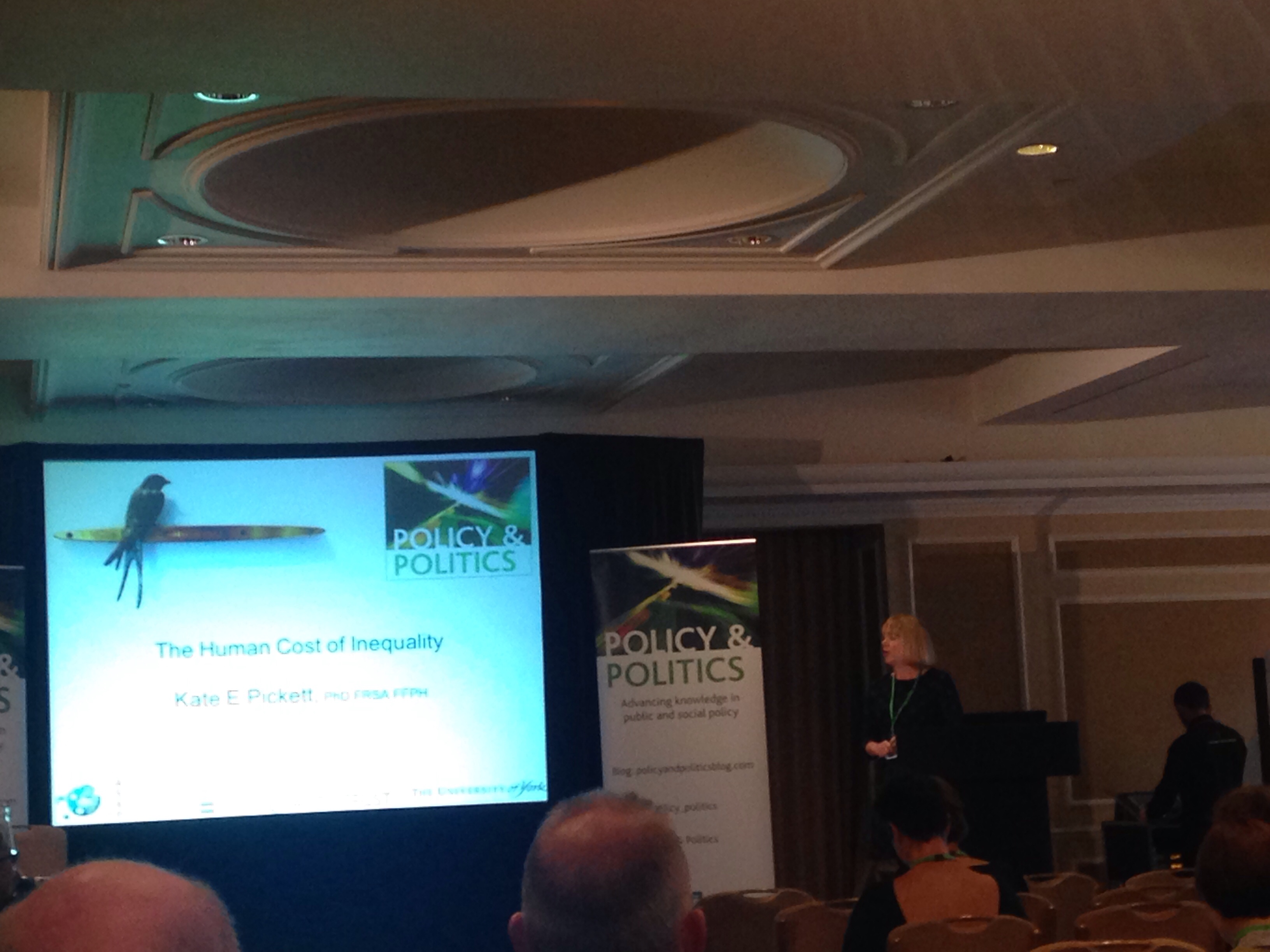
The human cost of inequality

IMG_3932by Tessa Coombes, guest blogger for P&P conference 2015

The second day of the conference started with an excellent presentation from Prof. Kate Pickett, from the University of York. Kate co-authored the influential book “The Spirit Level” which provided evidence to illustrate how almost everything is affected not by how wealthy a society is but how equal it is. The book was written at a time when inequality was not being discussed, and even now, whilst it is indeed the subject of much more debate on an international stage, it is still only rhetoric, and we are still waiting for this to translate into real action.

There are some shocking statistics that illustrate the level of the challenge we face across the globe, such as the one used by Oxfam – the 85 richest people on the planet have the same wealth as 3.5 billion of the poorest people – illustrating a truly grotesque level of inequality. But, as Kate pointed out, we need to remember that these are not just meaningless, abstract numbers, they represent real human suffering and have real impacts. Continue reading