Neoliberalism by stealth? Exploring continuity and change within the UK social enterprise policy paradigm

nicholls-teasdaleAlex Nicholls (University of Oxford) and Simon Teasdale (Glasgow Caledonian University)

Since the late 1990s the idea of social enterprise – broadly speaking businesses that trade for a social purpose –has received considerable academic and policy attention. It is probably fair to say that opinions are polarised. On the one hand we have those who see social enterprise as a new paradigm whereby localised civil society responses to social problems achieve financial sustainability through economic activity and regenerate and reinvigorate communities.  Alternatively critics, particularly from the left, see social enterprise as an extension of a neoliberal paradigm whereby policies to extend market discipline and competition have been extended throughout society, and responsibility for welfare provision moves from state to communities.

In a recent article in Policy & Politics entitled Neoliberalism by stealth? Exploring continuity and change within the UK social enterprise policy paradigm, we developed recent work on policy paradigms (broadly speaking a coherent set of ideas and norms that specify policy goals, instruments and problems). Continue reading

“Politics in Interesting Times” – Report from the Annual Political Studies Association Conference, University of Strathclyde

felicity-matthewsFelicity Matthews (University of Sheffield), Co-Editor of Policy & Politics

Politics in Interesting Times”.  Has ever a conference title been so apt, or provided such a unifying theme?  This year’s PSA Conference, held at the University of Strathclyde in Glasgow, was host to a record number of delegates, who had travelled from 75 countries to reflect on the interesting times that we inhabit.  Brexit, Scottish independence, forthcoming elections in Italy and France, the election of Trump, the decline of traditional parties, the rise of populism, new forms of representation and participation.  All of these issues – and many, many more – were discussed, debated and often contested within the conference’s ten panel sessions. Continue reading

Communities First?  Governing neighbourhoods under austerity

Welsh Government is phasing out its (former flagship) Communities First tackling poverty programme from 2017/18.  The Bevan Foundation, a think tank, has stressed that subsequent local action should be led by ‘community anchors’ – community-based organisations with a good track-record and strong community engagement. In a recent article published in Policy & Politics, we use the conceptual framework of hybridity – conducted as part of the Transgob project in Cardiff, Wales – to support this recommendation, and highlight the need for local government to relinquish its former levels of control to give these organisations space to develop approaches which work for their communities.

The research explored what austerity means for participation in city governance.  The optimistic view is that making governance more participatory can help overcome the hurdles of bureaucracy, with government ceding control to enable capacity to address complex problems.  The pessimistic view is that city governance remains dominated by state elites, with third sector and community partners co-opted to compensate for the decline in state provision, compromising their ability to advocate for and ensure that communities get decent services.  In Cardiff we uncovered attitudes and practices somewhere in between these two views.

We found that austerity had accelerated the city council’s use of its city governance structure, the Cardiff Partnership, to share the risk and responsibility of service delivery with other public organisations, but also with third sector organisations and neighbourhood-level community groups.  Communities were certainly having to take more responsibility for delivering their own (formerly public) services, such as play and youth services and the maintenance of parks, sports grounds and streets.  Those at the neighbourhood frontline faced tensions and power conflicts in trying to develop workable practice.

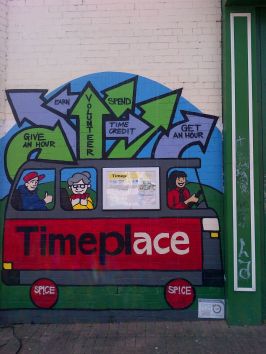
But we did find that community-based organisations had some room for manoeuvre in developing forms of co-production that were rooted in communities as well as responding to the strictures of funding cuts.  One example was timebanking, championed by a deprived community-based organisation in south Cardiff.  The approach means that volunteers can exchange equivalent hours of providing a service such as kids’ school holiday activities for other services.  The scheme was underpinned by the council offering access to facilities such as swimming pools, but the opportunities to spend credits earned within the community were expanding, indicating potential for it to become self-sustaining (and thus definitively community-led).  But it was too early in our research to tell whether attempts to replicate it will be successful.
mpill

Credit: photograph taken by Madeleine Pill of the mural celebrating ‘Timeplace’, a community timebank running in the Cardiff neighbourhoods of Ely, Caerau, Fairwater and Pentrebane.  Timeplace is run by ACE (Action in Caerau & Ely) http://www.aceplace.org/timeplace/, a community-based organisation, in partnership with Spice,http://www.justaddspice.org/, a specialist timebanking non-profit organisation.

The city council was also seeking to transfer assets such as libraries and community centres to communities.  The frustrations of this process – such as the need for willing community groups to become formalised organisations – showed the need for change in the council’s attitudes to risk.  In the words of a Welsh Government officer, government needs to ‘recognise that the cheapest and best way to achieve real things is to spot what people are doing for themselves and support them’.

When the Communities First programme was reshaped in 2011, Cardiff Council innovated by contracting community-based organisations to manage the four deprived neighbourhood ‘clusters’ eligible for programme support. In so doing, the council downloaded risk and offloaded staff costs as the organisations took on responsibility for finance, HR and evaluation – thus becoming hybrid third-public sector organisations.  Their staff had to navigate the tensions and dilemmas of implementing a (national) programme, engaging in the (city-wide) strategy overseen by the Cardiff Partnership, and the needs and demands of their communities.  Doing this aligned with the demands of austerity, enrolling these community organisations into service delivery in ways that included voluntarism, thus increasing community self-reliance.  But we also found, to an extent, that community organisation staff were able to innovate (such as with timebanking) – and in ways that maintained their community-focused mission.

Therefore our Cardiff research shows how the ‘devolution, decentralisation and downloading’ of Peck’s (2012) ‘austerity urbanism’ encourages hybridity at a scalar, organisational and individual level.  But our research also reinforces the need to understand local practices to provide insight beyond the dualism of empowerment or incorporation.  The Cardiff experience of participatory governance demonstrates the potential for transformative alternatives in the everyday and the small-scale – and also highlights the need for state supports rather than constraints in these processes.   In the case of Wales, the need to sustain the work of community anchors should be a priority.

The ‘Transgob’ project analysed the discourse and practice of participatory urban governance under austerity in two British (Cardiff and Leicester) and four Spanish cities.  It was funded by the Spanish government’s National Research and Development Plan (reference CSO2012-32817).

Dr Madeleine Pill is a Lecturer in Public Policy at the University of Sydney, Australia, and Valeria Guarneros-Meza is a Senior Lecturer in Public Policy, based at De Montfort University, in the UK.

If you enjoyed this blog post you may also like to read Community asset transfer in Northern Ireland by Brendan Murtagh.

Making sense of neoliberalism in the era of Brexit and Trump

Christopher ByrneChristopher Byrne, University of Exeter

The term neoliberalism is most commonly used to refer to the free market-oriented reforms enacted by right-wing governments in the UK and US throughout the 1980s and 1990s, and continued by ‘Third Way’ politicians such as Tony Blair in the UK and Gerhard Schroeder in Germany into the 2000s and beyond. Recently, mainly as a consequence of ‘Brexit’ — Britain’s rejection of EU membership in a 2016 referendum — and the victory of avowed economic nationalist Donald Trump in the recent US presidential election, there has been talk of the end of the neoliberal era. Continue reading

A pathway to precarity? Young workers and zero hour futures in the social care sector

Montgomery-Mazzei-Baglioni-SinclairTom Montgomery, Micaela Mazzei, Simone Baglioni, Stephen Sinclair

In an effort to solve crucial issues such as youth unemployment, policymakers can find it tempting when it looks like there is an opportunity to kill two birds with one stone. When you have a population living longer and requiring personal care for many years to come it can seem logical that there is a future in that sector for a generation of young workers. However there is a risk that the prospect of new potential employment for young people eclipses an awareness of the quality of work available in that sector.

Our recent article in Policy & Politics entitled Who Cares? The social care sector and the future of youth unemployment explores the actual potential of the social care sector in the UK to offer good quality career pathways for young people. Continue reading

Vodcast to promote article: Relational Wellbeing: Re-centring the Politics of Happiness, Policy and the Self


Take a look at this short video by Professor Sarah White, Professor of International Development and Wellbeing at the University of Bath, who talks about her research, published in Policy & Politics, on why all the interest and talk of our wellbeing may reflect an anxiety that all may somehow not be well…


If you enjoyed this blog post, you may also like to read Policy, politics, health and housing in the UK by Danny Dorling.

Reflections on my article: “Creating public value through caring for place”

patsy-healeyPatsy Healey

Many of us these days are deeply worried about the tone and content of contemporary public debate and discussion about key issues which affect us in common. Somehow, the gulf which has long appeared between elites, experts, academics and everyone else has widened out dramatically. We seem to lead separate lives, imbibing separate ideas and creating separate crude stereotypes about others with whom we share our environments and our political institutions.

A century ago, from the struggles between labour and capital and between tradition and modernity, and the fight for the political rights of workers and women, some sense of a shared political community was forged. Today, while we pass our fellow citizens by on the bus, in the playground, at the supermarket or the doctor’s, or meet in a care home, how much do we understand of our various ways of life, struggles and challenges? Political institutions without some sense of what citizens of that community share in common is far from any conception of democracy. They become easy prey to the megaphones of contemporary populism, as we in the Western world are re-discovering. Continue reading

Blog from Annual Lecture: Will Self on the End of Champagne Socialism

Tessa Coombes, University of Bristol

@policytessa

The Policy and Politics Annual Lecture this year was delivered by Will Self. The theme of the lecture was ‘the end of champagne socialism’ and was presented as a mixture of personal reflections, concerns and challenges, all seeking to highlight the mess that Will believes politics has seemingly descended into right now.

The lecture was at times depressing, confusing and uncomfortable, whilst at the same time managing to be amusing, engaging and thought provoking. Will has a style of delivery that captures the imagination whilst challenging the mind, often leaving the audience unsure and uncertain about their own thoughts, but also in no doubt about the central message he is trying to convey. That message was about how things have changed, about how there’s been a shift in the way people view politics and politicians, and about how we are now seeing change for change’s sake without any real concept of the consequences.

Will described 2016 as a momentous year in Britain and the world, where a significant proportion of the electorate woke up to the fact that no one knows what is going on, even our leaders don’t know what is going on, and for once enough people woke up to this fact and voted for change. The common theme of 2016 seemed to be that people just wanted things to change. They didn’t know what would happen as a result of that change, but they wanted change, a dangerous attitude to take to political events according to Will. In his words, what we are now seeing is ‘the rise of the idiots and the government of the stupid’.

He then went on to explain this desire for change as a break from the usual left-right dichotomy, exemplified by Brexit where the usual left versus right arguments couldn’t be applied. There were pro leave and remain campaigners on both sides of the political divide, the politics-as-usual approach no longer applied to the debate as the dualism deeply ingrained in British politics since the 1970s seemed to be unraveling.

On Corbyn, Will was conflicted. Whilst sharing many of the same beliefs as Corbyn he described how for some reason he was unable to feel pleased about his election as leader of the Labour Party. He went on to explain this using a series of examples about how Corbyn had failed to stick to his principles and wasn’t saying many of the things he should have on becoming leader. He appeared to feel let down by the failure of the new leadership to display honesty about what being a socialist party really means, about what a redistributive party would actually do, what they would change and what the impact of this would be. The disillusionment he clearly feels was apparent to all as he described the endless dilemma for politicians needing to ‘square the circle’ to retain votes meaning they generally lack any real ability to be honest about what they are trying to achieve.

He launched a scathing attack on the Labour Party and the British Left, who for over 40 years have sat back and done little whilst income disparities have grown consistently across the UK. He described them as sitting in their own bubble failing to acknowledge the changes that are needed. He was pretty damning about Tony Blair and Alistair Campbell, about their role in changing the very foundations of the Labour Party during what he calls the Blair Witch Project, the New Labour movement, that moved Labour away from its traditional support whilst at the same time re-creating a new breed of champagne socialists. This he describes as unsustainable, and a nonsense that will never work based as it is on the wealthy middle class socialists’ idea that everyone should be raised to the same level and that redistribution will mean personal betterment and improvement, rather than a reduction in their own personal wealth. He pointed out that there was little evidence of the kind of large-scale voluntarism that would be needed to bring about a socialist society. For example, who among the audience would be willing to curtail their annual spending to live within median average income levels, redistributing any surplus to others earning less than us?

Will seemed to reflect the experience of many in the audience when he challenged us about our own feelings, when he described how those on the left are currently unhappy with things, but that we had done little to actually change anything over the last 20 years as income disparities have increased. As he put it, we knew the poor were getting poorer, we knew inclusiveness was largely cosmetic but we didn’t do much about it and now we are really upset, but still don’t do much about it.

He went on to explain the impact of this on young people and how we need to speak to young people about the state of the world today. He explained that we should think long and hard about what we say to the younger generation and made the point that we live in a time of democratic crisis, where older people have capital and younger people don’t’. He then asked the question about how this affects our politics when our homes make more money in a year than we do and how do we square that circle with young people.

Will’s final comments focused on the hollowness of political rhetoric and how collective action can no longer work as there is no socialist dawn waiting for us and no wheel to put our shoulder against. His description of a new socialism based not on collective action but on autonomy and individualism is a difficult one to grasp. It relies on individuals making changes – for example giving directly to the homeless, picking up litter in our communities – and taking action in an arena where there is more quietism, compassion and thought. In his words, we don’t need to organize to help people, we need to show more compassion and just do something.

If you enjoyed this blog post, you may also like to read Making the case for the welfare state by Peter Taylor-Gooby.

Free article collection for the Policy & Politics Annual Lecture: Will Self on The End of Champagne Socialism

On 7 March Will Self delivers the 22nd Policy & Politics Annual Lecture about the end of champagne socialism.

He will examine developments in thinking about socialism over the past half-century – what the rise of Corbyn tells us about British attitudes towards socialism (and by extension capitalism), and what the changes have been in how we conceive – and repurpose – the links between the personal and the political in times of accelerated change.

To mark the occasion we are making a collection of articles that resonate with the theme of the lecture free to access until the end of March: Continue reading

Is universal health coverage possible without strong public presence in its provision?

volkan-yilmaz-jpgVolkan Yilmaz, Assistant Professor of Social Policy at Boğaziçi University, Turkey

As part of the Sustainable Development Goals, a United Nations (UN) initiative covering a broad range of development issues, all members of the UN set an ambitious and greatly welcomed target to be achieved in healthcare policy by 2030: achieving universal health coverage. The World Health Organisation (WHO) defines universal health coverage as a set of policies ensuring everyone in need of healthcare services and medications receive a quality service yet without facing financial hardship. This notion of universal health coverage leaves no room for denying services and medications to people in need.

However, as is often the case, the devil is in the detail. As far as indicators for monitoring progress towards universal health coverage are concerned, it turns out that this is a broken promise. Two indicators are in use: the share of population that can access ‘essential’ healthcare services and the share of population that spends a large amount of its income on healthcare. The second indicator is estimated on the basis of households having to spend a disproportionate amount of their total income on health, measured as 25 per cent or more of their total household expenditure.

The first indicator in particular seriously limits the scope of universal health coverage by leaving out healthcare services that are not defined as essential. For example, while cervical cancer screening is listed among essential services, cervical cancer treatment is not. The second indicator may help by putting an upper limit on the proportion of total household expenditure to be spent on non-essential health services, but it may still fail to capture how many people don’t seek medical help for these services.

Dr Margaret Chan, Director General of World Health Organization, clearly suggests that free markets do not work in health care. Chan’s emphasis is on the financing component. Specifically, if public funding of healthcare is weak, achieving universal health coverage is generally not possible. Therefore, she identifies increasing public expenditure on healthcare as the only way towards universal health coverage, which will result in less reliance on out-of-pocket payments.

But healthcare systems have two major components that are of importance in achieving universal health coverage: financing and provision. To achieve universal health coverage, while public funding of healthcare is key, exclusive focus on the financing component in ensuring universal health coverage might be misleading. I believe the significant role that the public sector can play in healthcare provision – and has already been playing in some countries – has been long overlooked. Failing to pay enough attention to the role of the public sector in healthcare provision can pose two obstacles in monitoring progress towards universal health coverage.

First, this focus may blind us to how the dominant role of private sector or privatisation trends in healthcare provision restrict access to healthcare services that are deemed non-essential. On the one hand, exclusive focus on essential health services may be interpreted as rationing, which is indeed necessary for all public policies due to budget constraints. On the other hand, the restrictive definition of essential health services may go beyond rationing especially for middle income and upper middle income countries with historically strong public provision systems. This restriction of the scope of universal health coverage to essential services may take the form of people’s aversion to seek medical help due to financial hardship and/or increasing expenditures on health as a proportion of total household incomes. In this regard, the proposed strategy of WHO to achieve universal health coverage may be implicitly granting approval to the privatisation of non-essential health services in countries with strong public actors in provision.

Second, this disregard for the ownership of providers in healthcare leaves out the possible impact of private sector dominance on provision in healthcare financing. Not all market designs foster competition and lead to lower prices for services. Not all countries have strong public regulatory capacity to protect patients from possible abusive practices of private providers. Finally, not all political actors in power are willing and strong enough to block private providers’ demand for higher out-of-pocket payments and/or switch to private health insurance based financing models. Concerning these, WHO’s strategy falls short of addressing these concerns which may well affect the prospect or viability of universal health coverage in different countries.

My forthcoming book entitled The Politics of Healthcare in Turkey demonstrates that despite significant achievements towards universal health coverage in Turkey in the last decade, a country that Dr Chan also lists among best performers, striking the right balance between public sector and private sector in healthcare provision remains a challenge for Turkey. Passive privatisation in healthcare provision and the political dynamics it has generated, cast doubt on viability of universal health coverage.

Setting a target for all countries is not easy, especially given the vast differences among them and the presence of strong global interest groups against reforms towards universal health coverage. But these challenges should not lead us to settle for a narrowly defined version of universal health coverage as a global policy direction for all countries. I suggest therefore that the lack of focus on the provision component of healthcare systems in the global health policy debate must be re-thought, especially if we want to reclaim the proper meaning of universal health coverage.

If you enjoyed this blog post, you may also like to read When collaborative governance scales up: lessons from global public health about compound collaboration by Chris Ansell.