The challenges of implementing targets in UK government – a ‘multiple streams’ approach

boswell & rodriguesBy Christina Boswell and Eugenia Rodrigues

It has long been observed that policies can get lost in implementation. The best intended legislation or programme adopted by central government can get reinterpreted, distorted or even subverted when applied at local level, or across different areas of government. This was certainly the case with the British Labour government’s system of targets rolled out in the 2000s. Number 10 and the Treasury (the ‘core executive’) adopted a series of quantified performance targets designed to improve public services. And the government even monitored how far they were being achieved through rigorous reporting arrangements. But the targets were appropriated and applied in quite different ways across departments. What factors shaped how different parts of government implemented targets? Continue reading


Thomas Schillemans on media and governance

by Thomas Schillemans & Jon Pierre

Thomas Schillemans talks about his special issue of Policy & Politics with Jon Pierre on media and governance published in January 2016 and why his topic is important.

If you enjoyed this blog post, you might also like to read Depoliticization, governance and the state by Matthew Flinders and Matt Wood.

Dr Claire Dunlop on policy learning and policy failure

Dr Claire Dunlop talks about her motivation for editing a special issue on policy learning and policy failure, publishing January 2017, and why her subject is so important.

Professor R.A.W. Rhodes talks about the journal Policy & Politics

Professor R.A.W. Rhodes talks about the journal Policy & Politics at the Political Studies Association conference in Brighton earlier this week.

Policy & Politics at the Political Studies Association conference talking about how to get published

Sarah Ayres
Sarah Ayres

by Sarah Ayres, Co-editor, Policy & Politics

At Policy & Politics, we are passionate about ensuring that all of our published research is accessible, relevant and interesting for a broad range of readers worldwide. We are painfully aware of the huge proportion of research in general that is published in obscure outlets and read by very few people. This is why we invest heavily in promoting our content via our blog, our associates at Discover Society, LSE Public Policy and The Conversation and our social media channels. We’re so serious about this that we now have more twitter followers than any other international journal in the discipline!

In this blogpost, I’ve drawn on my experience of editing Policy & Politics for the last 4 years to set out a few golden rules to remember when submitting, although some of my points are relevant to getting published in academic journals more broadly. I should say these have been arrived at by looking at some of the most common reasons for rejection recently and by contrast, some of the papers which received most media and public attention.

Here are my 6 best tips: Continue reading

Policy & Politics 2016 best article prizes announced!

We are delighted to announce the 2016 prizes for award winning papers published in Policy & Politics in 2015.

The winner of the Ken Young prize for the best paper overall was awarded to Michael Howlett, Ishani Mukherjee & Jun Jie Woo for their 2015 article entitled ‘From tools to toolkits in policy design studies: the new design orientation towards policy formulation research, Policy & Politics, 43 (2), 291-311(21).

The winner of the Bleddyn Davies prize for the best early career paper was awarded to Owen Corrigan for his 2015 article entitled ‘Conditionality of legal status and immigrant occupational attainment in Western Europe’, Policy & Politics, 43 (2), 181-202(22).

Brief critiques of the winning articles follow, written by Co-Editor Felicity Matthews in celebration of their contribution. Continue reading

Governing, governability, the future of the state and other minor issues

Jon Pierre
Jon Pierre

Jon Pierre is Professor of Political Science at the University of Gothenburg and professor of public governance at the Melbourne School of Government, University of Melbourne. He serves on the editorial advisory board of Policy & Politics.

Two recent papers in the October 2015 edition of Policy & Politics  provoked my thinking about governing and governance; Bob Jessop’s “Crises, crisis-management and state restructuring: what future for the state?”, and Allan Cochrane, Bob Colenutt and Martin Field’s “Governing the ungovernable: spatial policy, markets and volume house-building in a growth region”. They did so for quite different reasons. Or so I thought.

The two texts could not be more different in style and presentation. For me, reading Bob Jessop has always been like having a bowl of fettuccine al burro in an Italian restaurant; it is pure delicacy but at the same time so incredibly rich that in order not to choke you have to proceed very slowly. You read a paragraph or even just a sentence (sometimes that can be one and the same thing) and then find yourself forced to sit back to take in and digest Bob’s argument. His analysis covers several discourses and perspectives, then puts a diachronic spin on the analysis and ends up asking Continue reading

2015 paper prizes are announced!

Last week at the conference dinner of the Policy & Politics Annual Conference, the 2015 prizes for award winning papers were announced.

The winner of the Ken Young prize for the best paper overall was awarded to Will Leggett for his 2014 article entitled ‘The politics of behavioural change: nudge, neo-liberalism and the state’, Policy & Politics, 42 (1), 3-19.

The winner of the Bleddyn Davies prize for the best early career paper was awarded to Caroline Kuzemko for her 2014 article entitled ‘Politicising UK energy: what “speaking energy security” can do’, Policy & Politics, 42 (2), 259-74.

Brief critiques of the winning articles written by Associate Editor Felicity Matthews in celebration of their contribution, follow. Continue reading

Can democracy survive?

IMG_3928by Tessa Coombes, PhD Researcher at Bristol University

For the final plenary session of the conference Prof. Andrew Gamble, from Cambridge University, took us back to the issue of democracy and its ability to survive and even thrive. We were reminded that for the first time in the modern state system authoritarian regimes are in retreat and representative democracy, in some form or other, is on the rise.

Representative liberal democracies have been described as the least admirable form of governance not least because of their inability to take difficult decisions and their short term thinking. Despite this, in the 20th century, representative democracy came to be seen as an ideal state. But it now seems we are in a time of transition, where there is a real disengagement and disillusionment with mainstream politics, where the choice is narrowing and where people are indifferent to their right to vote. This crisis of representative politics reflects a crisis of trust in our politics and politicians. Once more, despite this process, representative democracy Continue reading

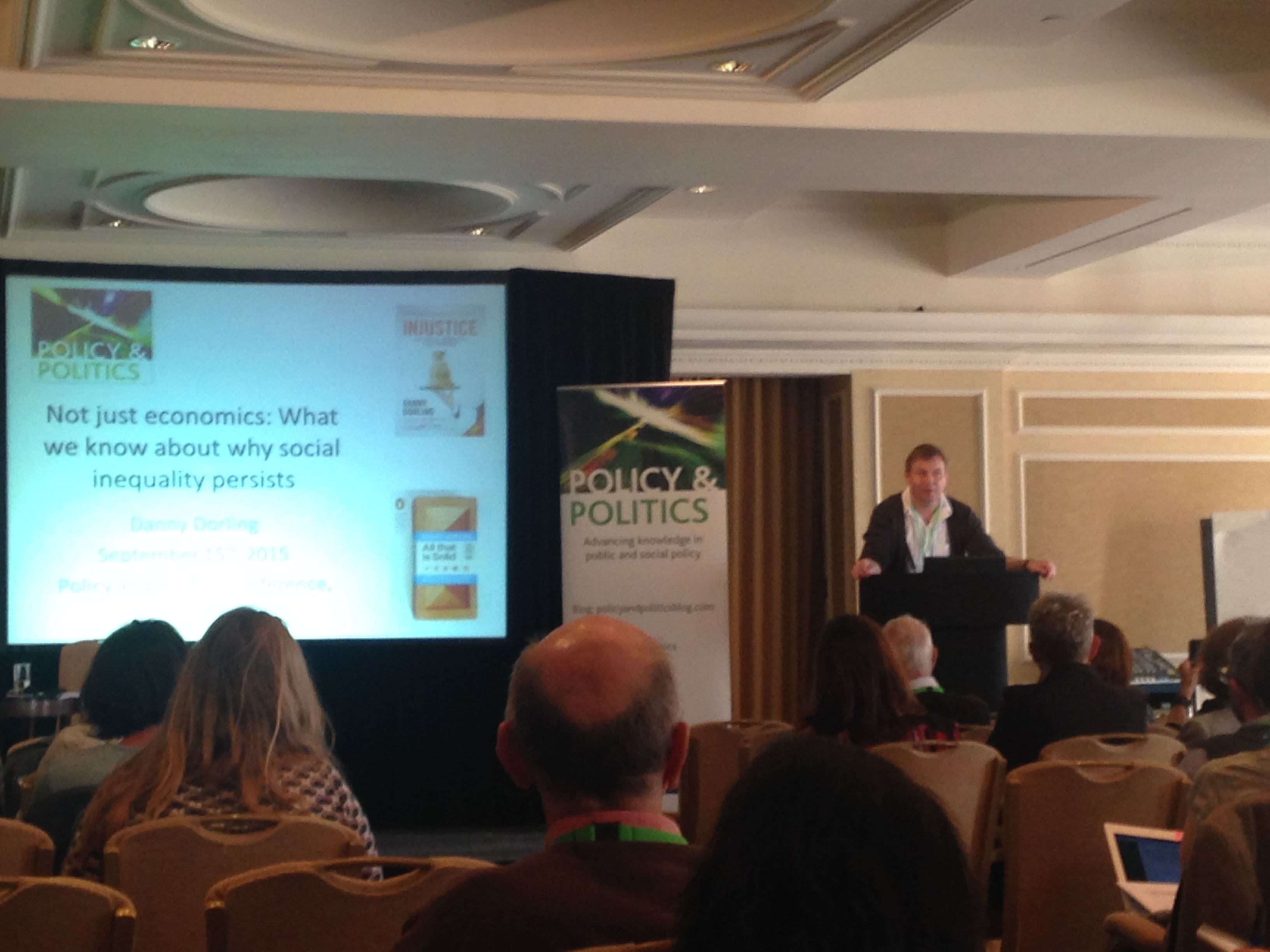
Why social inequality persists

IMG_3926by Tessa Coombes, guest blogger for P&P Conference 2015.

The second plenary session of the Policy and Politics Annual Conference was delivered by Prof. Danny Dorling, who provided a shocking and somewhat scary analysis of the increasing levels of inequality in the UK. The big question for us all to consider is why there is no consistent challenge to this situation and why we appear to accept the disparities that exist. Why is it acceptable and why would anyone think inequalities are a good thing?

One answer to the question is that we don’t actually realise how unequal we are as a society. But a quick look through some of the statistics soon provides the evidence we need. Danny took us through graph after graph that more than adequately demonstrated just how big the problem is and that it is increasing. One example to illustrate the point, in 2010 the best off tenth of the population in the UK were nearly 14 times better off than the worst off tenth. By 2015 this had grown to more than 17 times better off, and if the trend continues on a similar course in less than 20 years the best off will have over 24 times as much disposable income as the worst off. The problem is that the change is gradual, we don’t notice it so much and we get Continue reading